



SRE agent AIOps: is an SRE agent the same thing as an AIOps platform? Vendors use both words in press releases, sometimes for the same product. This article offers a reading grid: what the official documentation states, what is a sales argument, and which questions to ask before handing an on-call shift to an agent. Pages read on 31 October 2026.
A note on method: span.observer is an independent blog and has tested nothing on a live environment. The only facts kept are those a vendor documentation page states. Anything else is flagged as not stated.
SRE agent AIOps: two promises that should not be confused
AIOps, in the usual sense, covers anomaly detection, event correlation and root-cause search. These functions cut alert volume and point the investigation in a direction. A human then decides.
An “SRE agent” promises something else: running the investigation itself. It forms hypotheses, queries telemetry, reaches a conclusion and sometimes acts. The shift in vocabulary helps the vendor, because “autonomous” sells better than “correlation”. For an SRE the difference is concrete: who owns the decision, and on what evidence?
What the Datadog documentation states
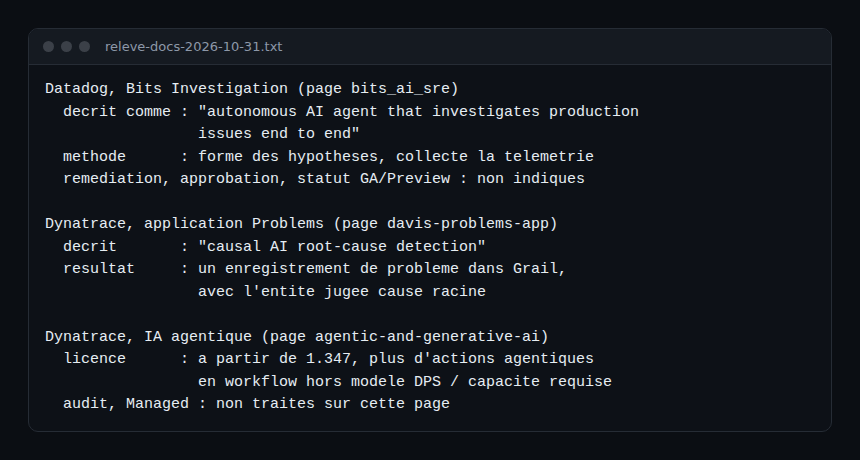
The Bits Investigation page (the product called Bits AI SRE in marketing) describes it as an “autonomous AI agent that investigates production issues end to end”. According to the same page, it iteratively forms hypotheses and gathers relevant telemetry. The page gives no availability status and no remediation action, and it links to an “AI Credits” billing page without quoting a price.
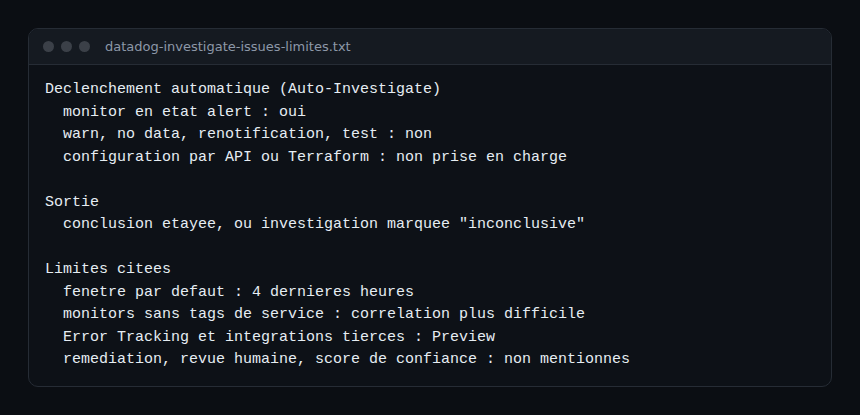
The page on starting investigations gives more precise facts:
- automatic triggering (Auto-Investigate) starts when a monitor enters the alert state; warn and no-data states do not trigger it, and API or Terraform setup is not supported;
- the result is either an evidence-backed conclusion or an investigation marked “inconclusive” when data is missing;
- the default window is four hours;
- monitors without service tags make correlation harder;
- Error Tracking investigations and third-party integrations are in Preview.
The knowledge-sources page adds that precise runbooks and a bits.md file describing the environment improve investigation accuracy, and that feedback on past conclusions becomes “memories” reused later. These are documented facts. They also say something useful: the agent is only as good as your runbooks and your tags.
What the Dynatrace documentation states
At Dynatrace, the Problems app page describes “causal AI root-cause detection”: it identifies issues triggered by one or more events, then saves the result as a problem record in Grail, marking the entity judged to be the root cause. The root-cause analysis page says it evaluates captured and ingested information, merges related anomalies into one problem and ranks the likely contributors. These pages describe AIOps in the strict sense: correlation and naming a cause, with no agent-led investigation.
The agentic and generative AI page sets a commercial frame: from version 1.347, customers outside the DPS model or without the required capability can no longer use agentic actions in workflows or the matching API calls, and use outside the UI is billed under the contract. That page does not cover auditing or Managed availability. For the announced-versus-delivered detail, see the article on autonomous SRE agents for Dynatrace.
Fact, hypothesis or sales argument: a four-column sort
This sort helps when reading any press release, from any vendor.
- Documented fact: a documentation page says it, with a status and a date. Example: a problem record stored in Grail, or an investigation’s four-hour window.
- Contractual fact: licence, quotas, billing. Example: the 1.347 licence condition. It weighs as much as the feature.
- Promise without a page: a product name in a press release with no named documentation. It stays to be verified.
- Sales argument: “autonomous”, “end to end”, “reduces MTTR”. None of these phrases counts as a measurement until the method and the dataset are published. Vendor figures must always be attributed to their author.
The word “autonomous” deserves particular care. In the pages read, neither vendor describes human approval or rollback for the investigation. That does not prove they are absent elsewhere, but it does not allow assuming them.
What this changes for an SRE or platform team
An investigation agent reads your telemetry, so it inherits its flaws: missing tags, uninstrumented services, outdated runbooks. Standard instrumentation matters here. Consistent traces and metrics, uniform resource attributes and a well-configured Collector serve any agent, whatever the vendor. The articles on the OpenTelemetry Collector on Kubernetes and on OpenTelemetry and Prometheus cover those foundations.
On alert noise, classic AIOps remains the first lever: reducing alert noise with Davis describes a verifiable approach. On risk, the questions are the same as for any production agent: minimal permissions, approval, audit trail, cost. See guardrails for AI agents in production. For a general comparison of the two platforms, see Dynatrace versus Datadog.
How to evaluate an agent without trusting the pitch
- Pick ten past incidents with a known cause, taken from your post-mortems.
- Replay them read-only, with no permission to act.
- Record for each: cause found, wrong cause, or “inconclusive”. An agent that admits uncertainty beats one that always concludes.
- Compare with the time a person would have needed, including the time to review the conclusion.
- Note the cost of each investigation from the official, dated billing page.
This method produces your own measurements, not vendor figures.
Best practices
- Require a named documentation page, with status and date, before adding an agent to a roadmap.
- Keep the agent read-only until its action trail is verified.
- Fix tags and runbooks first: the Datadog documentation ties conclusion accuracy to their quality.
- Attribute every vendor figure (“according to the vendor”) and never present it as an internal measurement.
- Re-read the licence terms: they change as quickly as the features.
Frequently asked questions
Does an SRE agent replace an AIOps platform?
The pages read present them as two layers: correlation and root cause on one side, agent-led investigation on the other. No page read says one replaces the other.
Can an SRE agent fix an incident on its own?
The Datadog pages read describe investigation and root-cause search, with no mention of remediation. For Dynatrace, check the workflows and agentic AI documentation for your version. When in doubt, keep human approval.
How can I tell whether an agent announcement is real?
Look for a documentation page that names it, with a status (general availability or preview) and a date. Without one, the agent remains a promise.
Conclusion
The official documentation describes precise functions, more modest than the word “autonomous”. The right reflex is to separate documented fact, licence condition, promise without a page and sales argument, then to measure on your own incidents. Sources: Datadog, starting an investigation, Dynatrace, Problems app and Dynatrace, agentic and generative AI, read on 31 October 2026.
span.observer is an independent community blog, not affiliated with Dynatrace LLC or Datadog Inc. Trademarks belong to their owners. Products change quickly: check availability, licensing and settings in the official documentation.