



The Dynatrace Arize acquisition is complete: on 1 October 2026 Dynatrace announced that it had closed its purchase of Arize, the vendor of an evaluation and observability platform for AI applications and agents. This article separates what has been announced from what is still assumed, then draws practical consequences for an SRE or platform team. Sources read on 27 October 2026: the closing press release, the initial announcement of 13 August 2026, the Phoenix documentation and the Arize-ai/phoenix repository.
A word of honesty: span.observer is an independent blog, not affiliated with Dynatrace or Arize. Official texts are analysed and reworded, never copied, apart from the one short quotation below. We neither installed nor tested Phoenix or Arize AX for this article, and we do not comment on the stock market.
Dynatrace Arize acquisition: what has been announced
- 13 August 2026: Dynatrace announces a definitive agreement to acquire Arize. According to that release, the price is 915 million dollars, subject to customary adjustments, including about 815 million in cash and the rest in replacement equity awards for Arize employees. Closing was then subject to regulatory approvals.
- 1 October 2026: Dynatrace announces completion. This second release gives no amount, so the figure above comes only from the August announcement.
- Stated intent: bring evaluation (testing an AI application before launch) and observability (watching it in production) together, to spot problems earlier and fix them faster.
- Products: Arize keeps supporting Phoenix (its open-source platform) and AX (its enterprise platform). Arize capabilities will be integrated into Dynatrace “over time”.
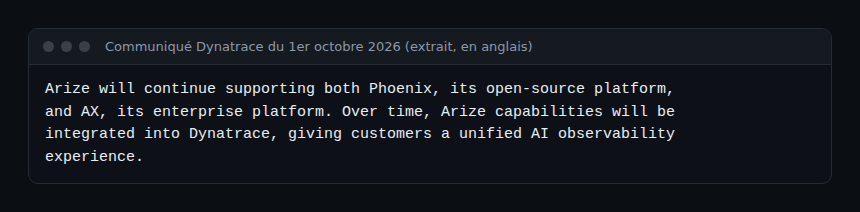
Quotation source: press release “Dynatrace Completes Acquisition of Arize”, dynatrace.com, 1 October 2026.
What remains assumed
The release describes a direction, not a timetable. It does not say which Arize features will reach Dynatrace, when, in which offers (SaaS or Managed) or at what price. It also carries the usual caution about forward-looking statements: planned integrations may differ from reality. Any schedule you read elsewhere is a guess until it appears in the vendor’s documentation.
Scope deserves attention. Dynatrace Managed and Dynatrace SaaS do not have the same capabilities, and nothing says so far that new AI features will cover both. We therefore do not claim it.
Phoenix: open source or source-available?
The release calls Phoenix open source. The Arize-ai/phoenix repository publishes its code, but its LICENSE file is the Elastic License 2.0 (ELv2). That licence allows use, copying and modification, with limits: among others, it forbids providing the software to third parties as a hosted or managed service giving access to most of its features. For internal use this is rarely a problem; for a provider wanting to resell Phoenix as a service, it matters. Read the full text with your legal team before any commercial use.
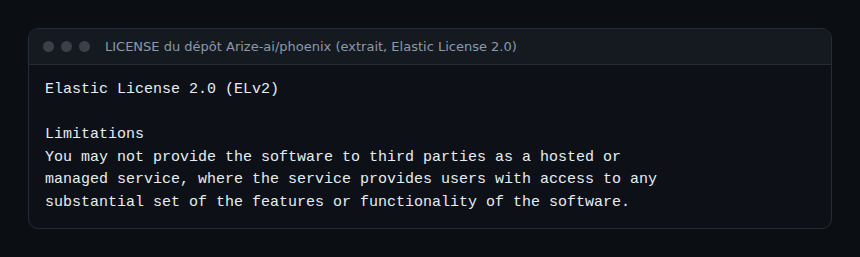
This is also why we do not reuse the repository’s screenshots: a software licence is not permission to reuse images. The captures in this article are real text extracts.
What Phoenix does, according to its documentation
The Phoenix documentation describes it as an observability and evaluation tool for debugging and improving AI applications. It lists four building blocks:
- Tracing: a step-by-step view of a run (model calls, document retrieval, tools). Phoenix accepts OTLP traces and builds on OpenTelemetry and OpenInference for instrumentation.
- Evaluation: scoring traces with LLM-based evaluators, code-based checks or human labels.
- Prompt engineering: prompt versions, tests on real examples, replay of calls.
- Datasets and experiments: group traces into datasets and compare evaluation results between versions.
The README adds a remote MCP server (the /mcp endpoint) to query traces and experiments from an MCP client. Arize AX is presented as the managed enterprise platform built on the same open standards; the official comparison page details the differences.
Trying Phoenix locally
If you want to judge the tool yourself, the README offers two commands. They are quoted from the repository, not run by us.
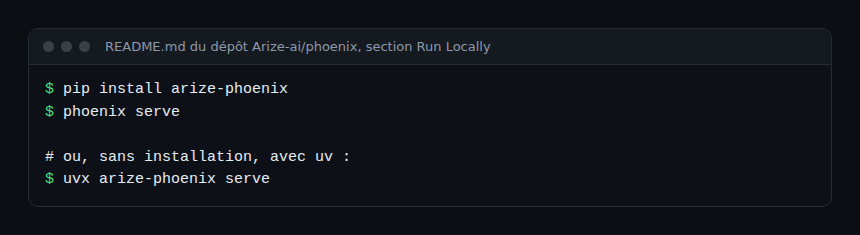
- Install and start:
pip install arize-phoenixthenphoenix serve. - Or without installing, using uv:
uvx arize-phoenix serve. - Then send OTLP traces from your application, following the tracing guide in the documentation.
How to check it works: your application’s traces appear in the Phoenix interface, with model and tool calls as child spans. If nothing arrives, check the OTLP exporter address and protocol before blaming the tool.
The engineer’s angle: what to do now
Our guide to end-to-end AI observability describes the whole loop: trace, evaluate, monitor, fix. The acquisition does not change that method; it signals that Dynatrace wants to offer it in one platform. Until details arrive, three decisions are reasonable.
- Instrument with open standards: OpenTelemetry and its GenAI conventions. Your traces stay portable whatever the final tool.
- Evaluate before shipping: a reference question set and a quality threshold in the pipeline. The release stresses this idea, and it depends on no product.
- Link AI and operations: track token cost and latency per step, as in our article on the token cost of an AI agent with OpenTelemetry.
For agents, two more reads complete the topic: supervising an enterprise coding agent and guardrails for AI agents in production. For SREs, an agent is a service like any other: it has service level objectives, an error budget and incidents to review without blame.
Best practices
- Date every piece of information and name its source (release, documentation, repository).
- Do not plan a migration around an unpublished roadmap.
- Keep the option to switch tools: open standards, exportable data.
- Have the ELv2 licence reviewed before any commercial use of Phoenix.
Frequently asked questions
What was the price of Dynatrace’s acquisition of Arize?
The 13 August 2026 announcement states 915 million dollars, subject to adjustments, of which about 815 million in cash. The 1 October closing release repeats no amount.
Does Phoenix stay available after the acquisition?
According to the 1 October 2026 release, Arize keeps supporting Phoenix and AX. The repository is published under the Elastic License 2.0; check its terms before commercial use.
Should you change your AI observability tool?
Nothing requires it today. Integration into Dynatrace is announced “over time”, with no timetable. Instrument with OpenTelemetry and reassess when the official documentation clarifies the scope.
Conclusion
The acquisition is closed; the integration is still to come. Keep the method more than the news: trace, evaluate before production, monitor after, with open standards. Sources: press release of 1 October 2026, announcement of 13 August 2026, Arize-ai/phoenix repository and Phoenix documentation, read on 27 October 2026.
span.observer is an independent community blog, not affiliated with Dynatrace LLC or Arize. Brands mentioned belong to their owners. Information changes fast: check it in the official documentation.