



The OTLP APM Server question comes up as soon as you want to send OpenTelemetry data to Elastic: should your applications point at the OTLP intake of APM Server, or go through an EDOT Collector? This decision guide explains both paths, the endpoints to know, the pitfalls and what Elastic’s documentation recommends. It is not about Dynatrace Managed or SaaS: it is an Elastic topic, seen by an SRE or platform team that standardises on OpenTelemetry. Official pages consulted on 30 October 2026.
The choice matters because it sets the storage format (native OTel or translated to ECS), the usable SDKs and how easy a later migration will be.
OTLP APM Server or EDOT Collector: the summary
- For a new project, Elastic’s documentation recommends sending to Elastic Agent or to the Managed OTLP endpoint “instead of to the APM Server”.
- The OTLP intake of APM Server is presented as a legacy path: data is translated to ECS before storage.
- EDOT SDKs are not supported with that intake, according to the limitations page.
- The protocol does not change: it is the same OTLP, over gRPC (default port 4317) or HTTP (default port 4318).
What each path does
APM Server OTLP intake
APM Server accepts OTLP/gRPC and OTLP/HTTP on the same port as the Elastic APM agents, according to the documentation. Your applications, or any OpenTelemetry Collector, send straight to that port. The benefit is simplicity: no extra component if you already run an APM Server.
EDOT Collector and Elastic Agent
EDOT (Elastic Distribution of OpenTelemetry) groups OpenTelemetry distributions tailored to Elastic: a Collector and several language SDKs. Per the documentation, since Elastic Agent 9.2 the OpenTelemetry Collector runs inside Elastic Agent and shares its configuration file, so a separate binary is no longer needed. On Elastic Cloud Serverless there is no APM Server: managed inputs receive and transform the data.
Managed OTLP endpoint
On Serverless and Elastic Cloud Hosted, this entry point stores data in native OTel format. It avoids the ECS translation, which changes the dashboards and queries available to you.
Decision tree
- Are you on Elastic Cloud Serverless? There is no APM Server. Use the Managed OTLP endpoint or Elastic Agent.
- Do you use EDOT SDKs? Avoid the APM Server intake: they are not supported there. Aim for Elastic Agent or the Managed OTLP endpoint.
- Starting a new deployment? Follow Elastic’s recommendation: Elastic Agent (with the built-in Collector) or the Managed OTLP endpoint.
- Existing fleet of Elastic APM agents and APM Server? The OTLP intake still works, with its limits. Plan the migration rather than extending it.
- Want control over routing? Put a Collector (gateway) in front of the backend, as in our article on the OpenTelemetry Collector on Kubernetes.
Endpoints and pitfalls
The OTLP specification sets the defaults: 4317 for gRPC, 4318 for HTTP, and three paths for HTTP.
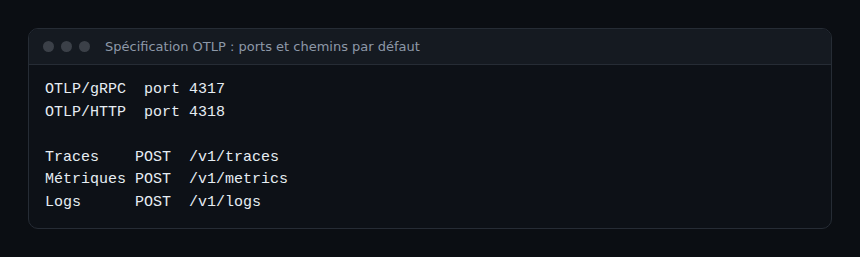
Several pitfalls come up in Elastic’s documentation:
- One port, two protocols. On APM Server, gRPC and HTTP share the port. gRPC requests need HTTP/2 (TLS or H2C). A layer 7 load balancer may not handle both: Elastic prefers an L4 TCP balancer, such as an AWS NLB. Behind a proxy, OTLP/HTTP is simpler.
- Protobuf only. OTLP/HTTP accepts protobuf only, not JSON.
- The paths. With an HTTP exporter, an SDK appends
/v1/traces,/v1/metricsand/v1/logsto the base URL. The Elastic pages I read do not detail these paths for APM Server: check them against the APM Server page for your version before hard-coding them. - Logs. The OTLP logs intake is in technical preview on APM Server, with dynamic mapping disabled on the data stream.
- Ingress NGINX. Use the
otlpexporter with the gRPC backend-protocol annotation, orotlphttpwith the HTTP annotation.
Example: a gateway Collector to Elastic
Here is an excerpt of the Gateway configuration from the EDOT Collector documentation: it receives OTLP on both ports and exports in native OTel mode.
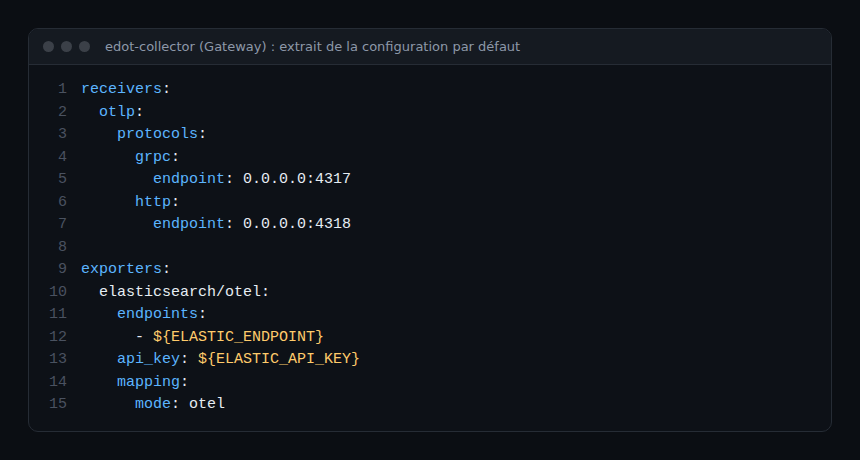
Two lines matter. mapping: mode: otel keeps the OpenTelemetry model. The documentation also describes an elasticsearch/ecs exporter for the ECS format (not reproduced here). ELASTIC_ENDPOINT and ELASTIC_API_KEY are your own values: never write them in clear text in a repository.
What you give up with the APM Server intake
Elastic’s limitations page lists the trade-offs of the legacy path.
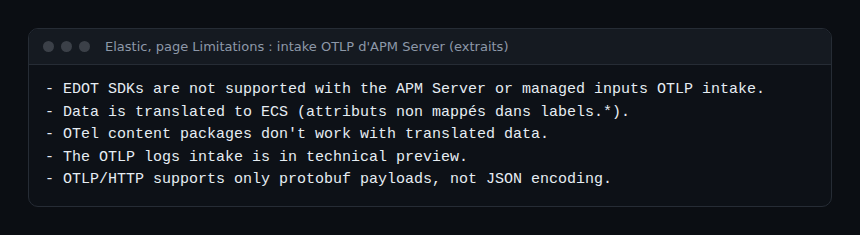
For an SRE, two points weigh most: unmapped attributes land in labels.*, which complicates queries, and OpenTelemetry content packages do not work with translated data. The same page notes that tail sampling in the Collector can skew throughput metrics: see our article on OpenTelemetry tail sampling.
How to check that it works
- In the Collector or Elastic Agent logs, look for export or receive errors (401, 403, connection refused).
- Send a test trace from an application and check that it appears in Observability under the right service name.
- Compare a query on a custom attribute: in native OTel it keeps its name, in translated ECS it may end up in
labels.*. - Behind a load balancer, test gRPC and HTTP separately.
Best practices
- Standardise on OTLP in your applications: the backend choice stays reversible. See OpenTelemetry and Prometheus for the common-standard logic.
- Put a Collector between applications and backend, so you can change destination without redeploying services.
- Record the Elastic Agent or APM Server version you use: the documentation evolves (the EDOT page lists Elastic Agent 9.5.5 on 30 October 2026).
- Tie this choice to a data-quality SLO: lost or badly mapped traces raise MTTR.
Frequently asked questions
Is direct OTLP to APM Server deprecated?
Elastic’s documentation calls it “legacy” and advises against it for new users. It does not say it stops working, but it documents its limits.
Can I use a standard OpenTelemetry SDK with APM Server?
Yes, the intake accepts OTLP. It is the EDOT SDKs that are not supported with that intake, according to Elastic.
Do I need a separate Collector with Elastic Agent?
No, since Elastic Agent 9.2 according to the documentation: the Collector runs inside the agent and shares its configuration. A separate Collector remains useful for multi-backend routing, for example towards several tools.
Conclusion
For a new deployment, follow Elastic’s recommendation: Elastic Agent or the Managed OTLP endpoint. Keep the APM Server OTLP intake for an existing fleet, knowing its limits. Sources: Elastic’s OpenTelemetry documentation, EDOT reference.
This site is an independent blog, not affiliated with Dynatrace LLC or Elastic N.V. Elastic information comes from its public documentation, consulted on 30 October 2026; check it for your version.