The OWASP MCP Top 10 is a list of ten security risks specific to the Model Context Protocol, published by OWASP. For an SRE or platform team, it works as a reading grid: every MCP server exposed to an assistant or an agent can be compared with these ten entries. This article summarises them, shows which ones matter most for MCP servers left reachable on a network, and offers a four-step review plan.
The project is young. Its official page, consulted on 31 October 2026, shows a roadmap in “Phase 3 – Beta Release and Pilot Testing” while also listing it among “Production Projects”: the signals conflict, so the list should be read as a living document. The entries below are paraphrased; only the original numbering is kept.
This guide complements our articles on how to secure an MCP server and on auditing MCP servers in the enterprise. It replaces neither the MCP specification nor the OWASP source.
OWASP MCP Top 10: the ten entries at a glance
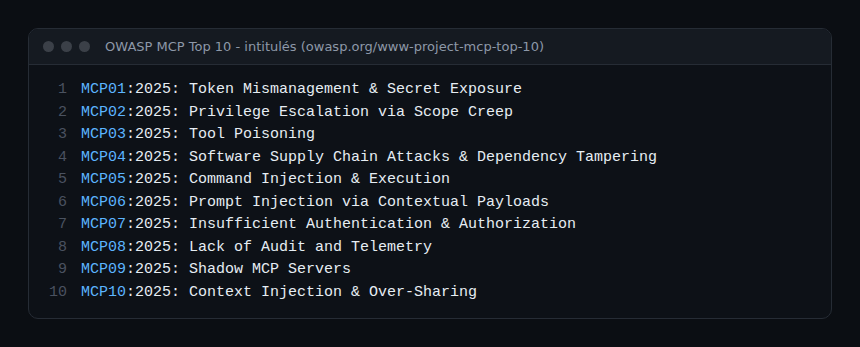
The project page numbers the entries MCP01 to MCP10, each suffixed “2025”. The image below shows the titles exactly as published.
In one sentence each:
- MCP01, token mismanagement and secret exposure: hard-coded credentials, long-lived tokens, secrets ending up in model memory or logs.
- MCP02, privilege escalation through scope creep: loose or growing permissions give the agent more capabilities than it needs.
- MCP03, tool poisoning: a tool, a plugin or their outputs feed misleading context that steers the model.
- MCP04, software supply chain attacks: a compromised dependency changes the agent’s behaviour.
- MCP05, command injection and execution: the agent builds and runs commands from untrusted input without validation.
- MCP06, prompt injection via contextual payloads: instructions hidden in text are followed by the model.
- MCP07, insufficient authentication and authorisation: servers, tools or agents do not verify identities or rights.
- MCP08, lack of audit and telemetry: too little logging of tool calls and context changes.
- MCP09, shadow MCP servers: unapproved deployments running outside security governance.
- MCP10, context injection and over-sharing: shared or persistent context exposes information from one task, user or agent to another.
Why exposed MCP servers are the sensitive spot
An MCP server open on the network stacks several entries at once. Without authentication (MCP07), any client that reaches it can call its tools. If its token is too broad (MCP01, MCP02), the call inherits that power. If it is not inventoried (MCP09) or not logged (MCP08), nobody notices.
The MCP specification is precise on this for the HTTP transport. In version 2025-06-18, authorisation is optional, but an HTTP implementation that supports it should follow the specification, while a STDIO implementation should not and retrieves its credentials from the environment. In other words, an unauthenticated HTTP server is a valid configuration as far as the protocol goes: the team has to refuse it.
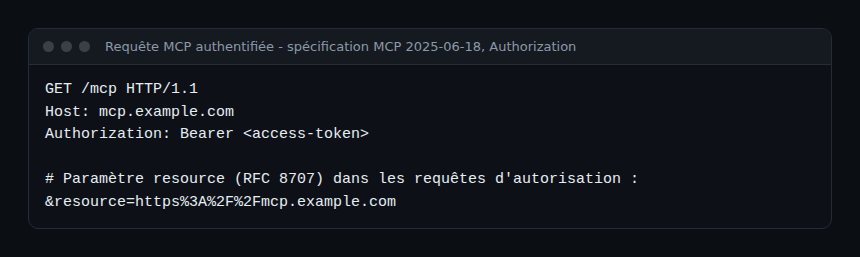
The same document sets several obligations worth checking during a review: the server must validate that the token was issued for it (audience), it must not accept or pass on other tokens, and the token travels in the Authorization header, never in the URL.
From the Top 10 to controls: a four-step review
Step 1: find the shadow servers (MCP09)
OWASP recommends a central registry of MCP servers, continuous discovery (port scans, traffic observation) and monitoring of standard MCP routes and unknown hosts. A first pass lists the declared servers, then compares them with what the network actually shows. For a suspect endpoint, a simple test checks the behaviour without a token:
curl -i -X POST https://mcp.example.com/mcp \
  -H "Content-Type: application/json" \
  -d '{}'
According to the MCP authorization specification, a protected server answers a request without a token with a 401 status and a WWW-Authenticate header. A reply that processes the request without authentication is a signal to investigate: either authentication is deliberately absent (local network, STDIO) or it is missing. The test is a hint, not proof: a server may answer differently for other reasons.
Step 2: check tokens and scopes (MCP01, MCP02, MCP07)
For each server, note where its token comes from, its lifetime and its permissions. MCP’s “Security Best Practices” document describes scope minimisation: a limited initial set covering low-risk read operations, then targeted elevation when a privileged operation is requested. It also lists catch-all scopes and publishing every possible scope among common mistakes. The same document explicitly forbids “token passthrough”: the server must only accept tokens issued for it.
Step 3: constrain tools and inputs (MCP03, MCP05, MCP06)
Treat every tool output as untrusted data, keep tools narrow, validate arguments on the server side. For detection in operations, see MCP tool poisoning and how to detect it with traces. For locally run servers, the specification recommends the stdio transport to limit access to the client, and, over HTTP, an authorisation token or Unix domain sockets with restricted access. Our article on isolating the commands of an MCP STDIO server covers this case.
Step 4: make calls observable (MCP08)
Entry MCP08 recommends structured logs that capture, among other things, the timestamp, agent and session identifiers, the tools invoked, the parameters and the user identity, with sensitive data masked. It names OpenTelemetry among the possible tools for end-to-end tracing and correlation. That is the natural link with observability: a tool call is an operation that can be represented as a span, as explained in monitoring MCP agents with OpenTelemetry. Attribute names depend on the version of the semantic conventions: check them in the OpenTelemetry documentation before fixing them.
How to check that it works
- The MCP server registry matches what network discovery finds: no unexplained gap.
- Every shared server answers 401 without a token, or a documented exception exists.
- Every token has an owner, an expiry date and limited scopes.
- For a test tool call, it is possible to find who requested it, which tool, with which parameters, and what the result was.
On the SRE side, these checks become indicators: share of inventoried servers, share of authenticated servers, time needed to trace the origin of a call. These indicators shorten diagnosis time during an incident and reduce the toil of manual reviews.
Best practices
- Read the Top 10 as a checklist, not a score: one server can match several entries.
- Cite the version of the source (OWASP list, MCP specification version) in every review.
- Treat the inventory as a prerequisite: what is unknown cannot be protected.
- Log before opening a server to users, not after the first incident.
- Repeat the review whenever the list or the specification changes version.
Frequently asked questions
Is the OWASP MCP Top 10 a final standard?
Not at this stage. The project page, consulted on 31 October 2026, mentions a beta and pilot testing phase in its roadmap. The content may change: cite the consultation date.
Is an MCP STDIO server affected?
Yes, for several entries: supply chain, command injection, tokens in the environment. The specification does state, however, that the OAuth authorisation described for HTTP does not apply to STDIO, which retrieves its credentials from the environment.
Should the OWASP Top 10 for LLM applications be consulted too?
The two complement each other: the LLM Top 10 covers models and their applications in general, while the MCP list targets the protocol and its servers. For figures and details, refer to each source.
Conclusion
The Top 10 gives a shared vocabulary for MCP risks. Applied to exposed servers, it narrows the review to three questions: is the server known, authenticated and observable? Keep these sources at hand: the OWASP MCP Top 10 project and the MCP security best practices. For the protocol basics, see the Model Context Protocol explained.
span.observer is an independent community blog, not affiliated with Dynatrace LLC or the OWASP Foundation. Trademarks belong to their owners. Content consulted on 31 October 2026; lists and specifications evolve: check the official sources.