


Cindy open source AI agent: the makecindy/cindy repository describes itself as “the open-source AI agent that works out of the box”. According to the README, it is a client that runs on your own machine, with your local files and logged-in apps, and drives existing agents (Claude Code and Codex today). The repository had about 6,300 stars at the end of October 2026.
For an operations team, the useful question is not the promise but the scope: what runs locally, what goes to a hosted service, and what you can measure. This article follows the README and the documents in the docs/ folder. For the wider picture, see supervising a coding agent in the enterprise.
A note on honesty: span.observer has not installed Cindy. The commands come from the README and the repository documentation, and the screenshots reproduce their text. The repository is recent and its footing calls for caution, detailed below.
Cindy open source AI agent: what the repository says
- Licence: Apache-2.0. The LICENSE file holds the standard licence text, with no named copyright line. The README adds that model weights, datasets, prompts, trademarks and third-party components may carry their own terms.
- Figures read on 26 October 2026: about 6,300 stars, 774 forks, about 1,700 open issues, 10,286 commits on
main. The release marked “Latest” is v0.1.115 (23 October); a v0.1.117-beta pre-release is dated 26 October. - Contents: a pnpm monorepo with
apps/desktop(Electron app),apps/mobile(Expo / React Native),packages/*(authentication, device linking, agent orchestration, model providers) andapps/*-bin(tool binaries downloaded per platform). - Idea: you can switch model mid-task while the workspace, memory, skills and tools stay intact. The README adds that the agent can control a browser, a computer and a phone, and take work from instant messaging and schedules.
- Service: the backend lives in a separate repository. By default, the client connects to Cindy’s official cloud services.
Tour of the repository: setup and local API
The repository does not publish a usable screenshot of the interface: its banner is a brand visual, which we do not reuse. The two images below therefore reproduce real content from the repository, rendered as text: the README commands, then the entry points of the local API described in docs/local-agent-api.md.
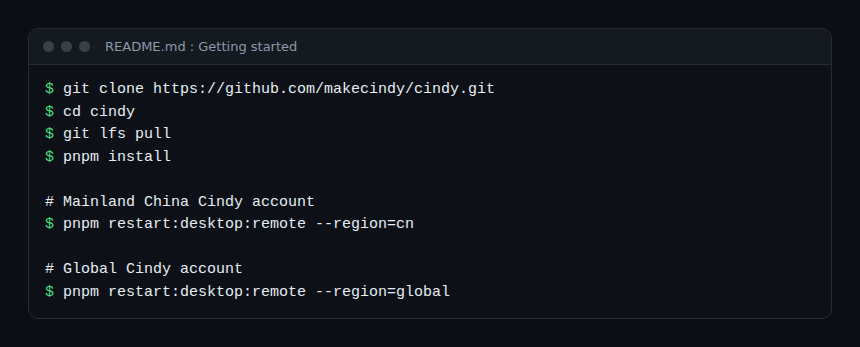
Step-by-step installation
Step 1 — Prerequisites
The README asks for Node.js 22.x, pnpm 10.x and Git LFS. It describes an Electron desktop client; macOS is not named explicitly, but the repository mentions Windows packaging and a Linux guide.
Step 2 — Clone and install dependencies
git clone https://github.com/makecindy/cindy.git
cd cindy
git lfs pull
pnpm install
Step 3 — Run the desktop client in development
# Mainland China Cindy account
pnpm restart:desktop:remote --region=cn

# Global Cindy account
pnpm restart:desktop:remote --region=global
The README states that “Skip Sign-In” runs local agents without an account, but server-backed features are then unavailable. You can also connect an existing Claude Code or Codex plan, your own API keys or local models.
Step 4 — Linux (Ubuntu, Arch, Omarchy)
docs/linux.md describes Ubuntu 22.04 and 24.04 through the official .deb package. For Arch and Omarchy it first lists the dependencies:
sudo pacman -Syu --needed curl jq libarchive coreutils util-linux findutils procps-ng \
  gtk3 nss alsa-lib libxss libxtst libnotify libdrm mesa \
  gnome-keyring libsecret desktop-file-utils xdg-utils
It then asks you to quit Cindy and run, without sudo, the command from the download page, for example curl -fsSL https://hotfix.cindy.app/cindy/install-omarchy.sh | bash. The document says this script is “pending website publication”. As with any curl | bash command, read the script before running it. Alpine (musl) and root desktop sessions are not supported; you need an unlocked Secret Service keyring and Electron’s user-namespace sandbox.
The local API: the point to watch
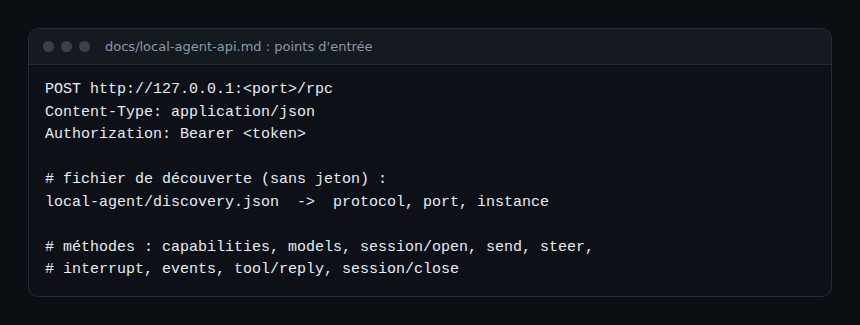
According to docs/local-agent-api.md, apps on the same computer can start agent sessions through an HTTP RPC on the loopback interface: POST http://127.0.0.1:<port>/rpc. The port is random and bound to 127.0.0.1; any request carrying an Origin header is rejected, so a browser cannot call it. Each app asks for its own authorisation, which the user approves in a Cindy dialog and can revoke one at a time. The document says it is not an OpenAI- or Anthropic-compatible endpoint.
- Tokens: kept in process memory, never in plaintext; the grants file stores only hashes.
- Tool policy:
client-onlyornative. Innativemode the agent runs with the user’s operating system permissions, and the working directory is not a sandbox. - Stated limits: 16 concurrent sessions, 32 grants, 8 pending requests, 16 MiB per request.
Observing Cindy
The README mentions neither OpenTelemetry nor metrics export. What the documents let you track:
- Local logs:
docs/working-directory-diagnostics.mddescribes working-directory diagnostic logs at info level, with theworkdir-diagnosticsscope and correlation fields (sessionRef,directoryRef,requestId,exitCode). Identifiers are keyed hashes that change at each restart, so they reveal no paths. The document advises finding the blocked check by time, then linking records throughsessionRef. - Log upload: the client has an upload entry; the
workdir-diagnosticsscope is allowed for upload because it holds only fixed event names, error codes, numbers and anonymous identifiers. - Telemetry: official builds include TapDB for aggregate usage statistics; a signed-in client sends an online heartbeat (account ID, platform, version). Crash dumps stay on the machine. A source build can remove analytics.
- Underlying agents: traces and costs come from Claude Code or Codex. See observing MCP agents with OpenTelemetry and the token cost of an AI agent.
Limits and open points
- Footing to qualify: we could not read the repository’s creation date. The earliest releases visible date from late July 2026 (the page shows no year; version tags indicate 2026). For roughly three months of existence, the repository already shows over 10,000 commits, over 7,000 numbered pull requests and 1,700 open issues: the history probably comes from earlier internal development. Stars prove neither maturity nor security.
- Version numbers: 0.1.x versions and frequent pre-releases (almost one a day in October) point to a fast-moving product.
- Partial repository: the server is in another repository; without an account, some features are missing.
- Code licence, not trademarks: Apache-2.0 covers the code; trademarks, prompts and datasets may carry other terms.
- Broad rights: the agent acts on your files, browser and even phone. Try it on a machine without secrets.
- Uneven documentation: some documents are plans or working notes, and at least one is written in Chinese.
- To compare with another agent controller, see T3 Code.
Best practices
- Install first on a disposable machine or profile, with no keys or sensitive folders.
- Read any
curl | bashscript and check the SHA-256 digest for the manual install. - Keep the local API in
client-onlymode when the client app does not need native tools. - Decide before use whether analytics and the heartbeat are acceptable, or build from source.
- Log approval decisions without hunting for blame: the goal is a more reliable flow.
Frequently asked questions
Does Cindy replace Claude Code or Codex?
No. According to the README, Cindy combines existing harnesses (Claude Code and Codex today) with models and tools; a native harness is announced for later.
Is it free and truly open source?
The README says the client is free and under Apache-2.0, and the LICENSE file is the standard text of that licence. The server is in another repository, and your model subscriptions or keys remain your own cost.
Can I use it without an account?
Yes, with “Skip Sign-In”: local agents work, but features that depend on the server are unavailable.
Conclusion
Cindy is an ambitious AI agent client under Apache-2.0, with a bounded local API and documented diagnostic logs. It is young, moves fast and its footing remains to be confirmed: try it away from your secrets before any adoption. Source: makecindy/cindy repository.
span.observer is an independent community blog, not affiliated with Dynatrace LLC or the projects cited. Trademarks belong to their owners. Tools change quickly: check commands and options in their official documentation.