




Module 6 of the SLO SLA training: how to write an SLA from your SLOs. Scope, measurement method, exclusions, maintenance windows, service credits, the margin between the internal SLO and the contractual commitment, reporting and reviews: the usual clauses of a service level agreement, seen through an SRE’s eyes.
Course: SLO SLA training · Module 6/6 · Duration: ~35 min · Level: Intermediate · Platform: tool-independent concepts; reporting with Dynatrace SaaS or Dynatrace Managed
An SLA commits the company to a customer: if it is missed, there is a consequence, often financial. An SLO is an internal objective the team sets to keep users happy. Module 1 (SLI SLO SLA) laid out this difference; this module shows how to go from one to the other without promising more than your measurement can prove.
Important notice: this module describes common clauses from a technical point of view. It is not legal advice and must not be used as a contract template. Have any SLA reviewed by your legal team.
Write an SLA from the SLO, not the other way round
The most common mistake is to copy the internal objective into the contract, or to set the SLA first under sales pressure and then discover the service cannot meet it. The healthy approach is the reverse:
- Measure the real SLI for several months (modules 3 and 4).
- Set an internal SLO the team meets, with an error budget policy (module 5).
- Offer an SLA that is less strict than the SLO: the gap is your safety margin.
The maths shows why this margin matters. Over a 30-day month (43,200 minutes), a 99.5% SLA allows 216 minutes of downtime, i.e. 3 h 36 min; an internal 99.9% SLO allows only 43 min 12 s.
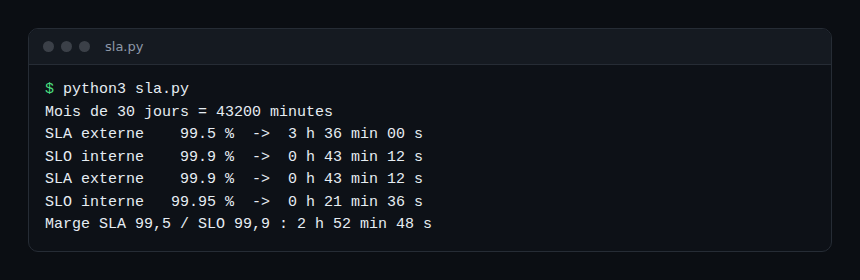
With this pair, the team freezes deployments (module 5) well before the customer can claim a credit: 2 h 52 min 48 s of margin remain. If both the SLA and the SLO are 99.9%, the first internal alert arrives together with the penalty.
The usual clauses of an SLA
1. Scope
Name the covered service precisely: which APIs, which application, which regions, which environments. “The platform” is not enough. Also state what is not covered: test environments, preview features, third-party components.
2. Indicator definition and measurement method
This is the clause where the SRE is essential. Write the SLI as a formula, for example “HTTP requests to the public API that received a non-5xx response, divided by the total number of valid requests”. State:
- the measurement point (load balancer, external synthetic probe, application agent);
- the authoritative data source, and who can access it;
- the granularity (per minute, per request) and rounding.
The choice between event-based and time-based SLOs, covered in module 2, changes the result: write down which one applies. To pick the indicator itself, see how to choose SLIs.
3. Measurement period
An SLA is usually measured over a calendar month, because billing follows the calendar. Your internal SLO can keep a rolling 30-day window: that is what drives the budget policy. State the reference time zone.
4. Exclusions
List what does not count as downtime: announced planned maintenance, incidents caused by the customer (misuse, quota overruns), force majeure, features disabled at their request. Be precise: a vague exclusion empties the SLA of meaning and fuels disputes.
5. Maintenance windows
Set a notice period, a maximum duration per month and a time slot. Unannounced maintenance counts as downtime. On the SRE side, align the SLO with this clause: if maintenance is excluded from the SLA, decide explicitly whether it consumes the internal budget.
6. Service credits and penalties
Public cloud SLAs most often provide service credits: a percentage of the monthly bill, increasing in tiers as measured availability drops. Also cover the claim procedure (deadline, evidence), the credit cap and whether the credit is the sole remedy. These points belong to legal and sales; the technical team’s job is to provide indisputable figures.
7. Reporting and reviews
Plan a monthly report (measured availability, incidents, excluded minutes and reason) and a periodic review, quarterly for example, to revise scope and objectives.
Producing the report with Dynatrace
- Dynatrace SaaS: SLOs from the Service-Level Objectives app can be added to a dashboard; the dashboard document format includes a tile of type
slothat displays an SLO by its ID. For a leadership report, see the SLO dashboard for leadership. - Dynatrace Managed: the Service-level objectives page shows the status, error budget, burn rate, target and timeframe of each classic SLO; the details show the trend over the period. The SLO API lets you extract these values for a report, as in Dynatrace Managed SLOs through the API.
In both cases, create a dedicated SLO that mirrors the contractual definition exactly (scope, exclusions, calendar period), separate from the operational SLO. That way an internal tweak never changes a contractual figure.
Hands-on exercise
- Take the SLO from module 5 and record its real SLI over the last three months.
- Propose an SLA target and compute the margin with the internal SLO in minutes.
- Write clauses 1 to 5 on one page, in precise technical language.
- Have a developer review the SLI formula: could they recompute it alone from the data?
How to check it works
- Recompute a past month’s availability from the written formula: the result must match the dashboard, give or take rounding.
- Replay the quarter’s incidents: is each one clearly included or excluded by the text?
- Check that the error budget policy triggers before any credit threshold.
Quiz
- How many minutes of downtime does a 99.5% SLA allow over 30 days? a) 43.2 b) 216 c) 360 d) 21.6
- Should the internal SLO be stricter than the SLA? a) Yes b) No, identical c) No, looser
- Does unannounced maintenance count as downtime under the sample clause in this module? a) Yes b) No
Answers
- b) 43,200 × 0.5% = 216 minutes.
- a) The gap is a margin: the team reacts before the penalty.
- a) Only maintenance announced under the agreed conditions is excluded.
Best practices
- A contractual SLI written as a formula both parties can recompute.
- An SLA looser than the SLO, with a margin expressed in minutes.
- A contractual SLO separate from the operational SLO.
- A systematic legal review: this module is no substitute.
Frequently asked questions
Should you write an SLA for every internal service?
No. Between teams of the same company, a published SLO and a budget policy are usually enough. An SLA makes sense when there is a customer, a contract and a consequence.
Can you promise 100% availability?
Technically no system achieves it, and a 100% target leaves no budget to ship. Such a commitment amounts to promising penalties.
Who should write an SLA in a company?
Legal and sales own the contract; the SRE team provides the SLI definition, historical data and a realistic margin. Without that technical input, the SLA promises what cannot be measured.
This module closes the course: you can define an SLI, compute a budget, create an SLO in Dynatrace SaaS or Managed, write the policy that goes with it and derive a sustainable contractual commitment. Go back to the overview to revisit a module.
← Module 5: error budget policy · Course overview
span.observer is an independent community blog, not affiliated with Dynatrace LLC. This module is neither legal advice nor a contract template. Check Dynatrace features against the official documentation for your version.