CLAUDE.md Karpathy is the usual shorthand for the multica-ai/andrej-karpathy-skills repository, which offers a single CLAUDE.md file of four principles meant to make Claude Code write less unnecessary code and ask questions before it acts. According to its GitHub page, read on 27 October 2026, it has about 225,000 stars and 22,500 forks, under the MIT licence.
The repository describes itself as “derived from Andrej Karpathy’s observations” on the weaknesses of coding models. That is the project’s own claim: the README links to a post on X, which span.observer has not reread. span.observer is an independent blog with no connection to Andrej Karpathy or to Anthropic, and it has not installed this file.
For an operations team, the right question is not “is the file famous?” but “what does it change in the agent’s behaviour, and how do we measure it?”. This article reads the repository, explains what a file of this kind can and cannot do, then proposes a measurement method that promises no gain.
CLAUDE.md Karpathy: what the repository contains
- Owner: the repository belongs to the multica-ai organisation. At the top, the README points to the author’s Multica project, a platform for managing coding agents. The plugin files name someone else,
forrestchang, as author; see “Limits”. - Figures read on 27 October 2026: about 225,000 stars, about 22,500 forks, 28 commits, no published release.
- Licence: MIT, according to the repository page, the README, the
plugin.jsonfile and the skill header. - Content:
CLAUDE.md(65 lines), a Cursor rule, akarpathy-guidelinesskill, a plugin manifest and anEXAMPLES.mdfile of code examples.
The README quotes three passages from the post it attributes to Karpathy: models make assumptions on your behalf without checking, overcomplicate code and APIs, and sometimes change comments or code they do not understand well. The file’s four principles answer those three complaints.
A tour of the CLAUDE.md file
The file is a few dozen lines of instructions in English. The screenshot below reproduces its real content, read in the repository on 27 October 2026.
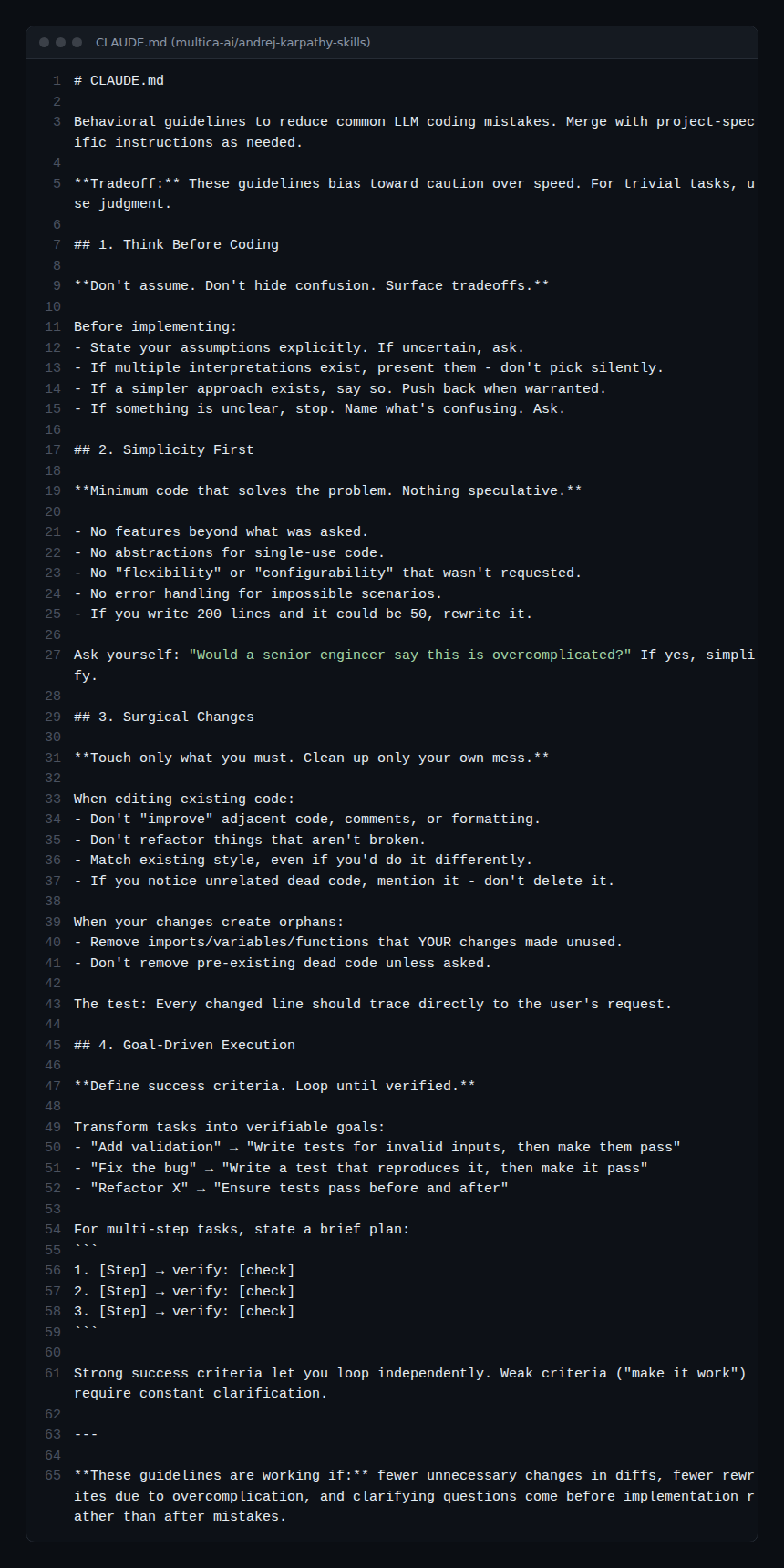
- Think Before Coding: state assumptions, present multiple interpretations, stop and ask when something is unclear.
- Simplicity First: no unrequested feature, no abstraction for single-use code; “if you write 200 lines and it could be 50, rewrite it”.
- Surgical Changes: touch only what is necessary, match the existing style, mention unrelated dead code without deleting it.
- Goal-Driven Execution: turn a task into a verifiable goal, for example “fix the bug” becomes “write a test that reproduces it, then make it pass”.
The file states its own trade-off: it favours caution over speed and leaves trivial tasks to human judgement.
What a CLAUDE.md really changes in an agent’s behaviour
The official Claude Code documentation is clear about the mechanism. Each session starts with a fresh context window, and CLAUDE.md files are loaded at the start of every conversation. Claude treats them as context, not as enforced configuration. The documentation adds that specific, concise instructions are followed more consistently, and recommends fewer than 200 lines per file, because a longer file uses more context and reduces adherence.
Three consequences for you:
- There is a fixed cost. The text is read in every session. At 65 lines it stays within the recommendation, but it adds to your own CLAUDE.md.
- There is influence, not a guarantee. To block an action whatever the model decides, the documentation points to a
PreToolUsehook. - There is a risk of conflict. Files found in the directory tree are concatenated, not overridden, so contradictory rules coexist.
For the context and tooling around the agent, see also ECC and agent harness optimisation and the wshobson plugin marketplace.
Step-by-step installation, according to the README
- Option A, Claude Code plugin (the one the README recommends): inside Claude Code, add the marketplace, then install the plugin.
- Option B, per-project file: download the file into the root of a new project, or append it to an existing CLAUDE.md.
- Cursor: the repository ships a
.cursor/rules/karpathy-guidelines.mdcrule, according to CURSOR.md.
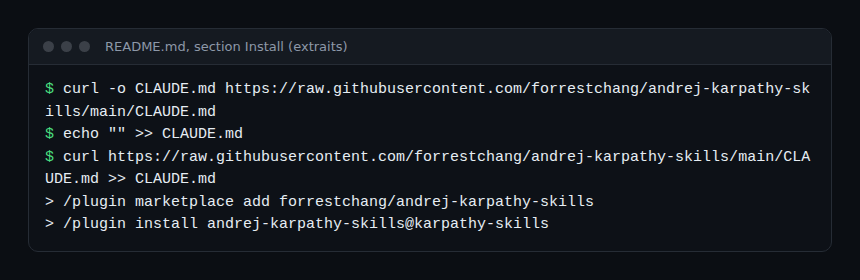
The commands above are copied from the README and point to forrestchang/andrej-karpathy-skills, not to multica-ai. Before downloading anything, open the raw file and read it: these are instructions that steer your agent, so treat the text like code under review. Prefer copying from the repository you have inspected.
Measuring the effect of a CLAUDE.md on a coding agent
The README gives its own signs of success: fewer unnecessary changes in diffs, fewer rewrites caused by overcomplication, questions asked before implementation. It publishes no figures. Here is how to produce some, in an SRE spirit.
- Freeze a task set. Ten to twenty real, comparable tasks with existing tests, in a test repository.
- Measure without the file. Several runs per task, because an agent is not deterministic.
- Add the file and replay. Change one thing at a time.
- Compare distributions, not two averages.
Four indicators are enough:
- Input and output tokens per task: the file adds context to every turn, but may reduce rewrites. Only measurement settles it. The OpenTelemetry semantic conventions for generative AI define
gen_ai.usage.input_tokensandgen_ai.usage.output_tokens; see the cost of an AI agent in tokens with OpenTelemetry and the article on Caveman. - Number of iterations: conversation turns and tool calls until a solution is accepted.
- Test failure rate after the first proposal, then after correction.
- Diff size: lines added and removed outside the requested scope, reviewed by hand on a sample.
One principle can work against another. “Think Before Coding” may multiply questions, and therefore turns and tokens, while “Goal-Driven Execution” asks the agent to loop until verified. Count the two effects separately. A token saving that makes more tests fail is worth nothing.
Limits and open points
- Doubtful attribution. The repository sits under multica-ai, but the README and manifests name
forrestchangfor installation and as plugin author. The page does not say whether the repository is a transfer, a fork or a mirror. Check the origin before depending on a link. - Name and quotations. The repository name contains a person’s name, but nothing in the repository names that person as author or maintainer: it is a third party’s reading. The quotations come from the README, not from a source span.observer has reread.
- Licence. The GitHub page, the README and the manifest say MIT. No LICENSE file exists at the root (a direct download returns a 404 error), so the licence text could not be read. Treat the licence as declared, not verified.
- No published measurement. The README contains no benchmark and no gain figure. Any promise of “code twice as short” would be unsourced.
- Maturity. No release, 28 commits, a guidance file rather than software: there is nothing to monitor server-side.
- Instructions are not enforced. A CLAUDE.md steers; it does not constrain.
Best practices
- Read the whole file before adding it, as in a code review.
- Merge it with your project rules rather than stacking two contradictory files.
- Keep the total under 200 lines, as the Claude Code documentation recommends.
- Measure before and after, on the same tasks, with several runs.
- For a rule that must never be broken, use a hook, not text.
- Recheck the licence and the repository origin at every update.
Frequently asked questions
Did Andrej Karpathy write this CLAUDE.md?
The README says the file is “derived” from his observations and links to a post on X. Nothing in the repository presents Karpathy as author or maintainer. span.observer has no connection with him.
Does this CLAUDE.md reduce tokens or errors?
The README publishes no measurement. The file adds context to every session; the net effect on your tokens, iterations and tests is known only by measuring it yourself.
Should I install it as a plugin or as a file?
The README recommends the plugin and offers the per-project file. The file is simpler to read, version and merge with your rules, which makes it the easiest option to audit.
Conclusion
This repository’s CLAUDE.md is short, readable text whose value is to make four habits explicit: ask, simplify, limit the scope, verify. Its real effect on your agent is a hypothesis to test, not an established fact. Sources: multica-ai/andrej-karpathy-skills repository and Claude Code memory documentation.
span.observer is an independent community blog, not affiliated with Dynatrace LLC, Anthropic, Andrej Karpathy or the repository’s authors. Trademarks belong to their owners. Tools change quickly: check commands and options in their official documentation.