
ArtCraft Craft suite open source creative tools: behind this name are two things. On one side, ArtCraft, an AI image and video creation application that presents itself as “an intentional crafting engine for artists, designers, and filmmakers”. On the other, a family of free desktop applications, the “Crafting Apps”, written in Rust by the same team, and a base of shared libraries. This guide describes the whole, what links it together, its licence and its limits.
In mid-October 2026 the storytold/artcraft repository showed about 30,400 stars and 4,800 forks, and its latest release read was v0.41.0 (late September 2026). The companion applications have audiences too: the GitHub organisation page showed, for example, about 65,000 stars for PhotoCraft, 15,000 for PdfCraft and 14,000 for FilmCraft. These figures are those of the GitHub pages (the organisation page for the applications) read on 16 October 2026.
A note on honesty: span.observer has neither installed nor run any of this software. This guide relies on the READMEs, the installation notes and the roadmap in the repositories, and on getartcraft.com. Where a repository says nothing, we do not fill the gap.
ArtCraft: the IDE for AI creation
The README describes ArtCraft as “the IDE for artists”: you compose in 2D, stage scenes in 3D, then choose the model that produces the image or video. The advertised features range from 2D and 3D image compositing to character posing, background removal and image to video. The repository groups the list into two families, “Advanced crafting” and “Quick prompting”.
On models, the README lists a catalogue of 62 models served by ArtCraft: 16 for images, 25 for video, 5 for music and sound, 11 for 3D meshes and 5 for worlds and Gaussian splats. They carry the names of third-party families (FLUX, Seedream, Veo, Suno, Hunyuan 3D and others). Several are marked “currently disabled” or “restricted, not available in the desktop app”. Other providers are named (Grok, Midjourney, Sora, World Labs), and the README announces Kling, Google, Runway and Luma as planned.
The project is a Tauri application: according to _docs/dev_setup.md, it is a “Rust / Tauri app” with a web front end, which needs Rust, Node.js and the Tauri CLI for development.
ArtCraft Craft suite open source creative tools: the applications
The getartcraft.com/apps page lists 13 applications. As read on 16 October 2026, PhotoCraft, PdfCraft and FigCraft are shown as “Early alpha” and the others as “In development”. Each has its own article in this series:
- PhotoCraft: image editing, layers, masks and PSD files;
- VectorCraft: vector illustration;
- FilmCraft: video editing, colour and sound;
- LightCraft: photo library and raw development;
- PdfCraft: reading, organising and protecting PDFs;
- EffectCraft: motion graphics and visual effects;
- DesignCraft: page layout and publishing;
- FigCraft: interface design and prototypes;
- WordCraft: word processing;
- GridCraft: spreadsheets and data analysis;
- CADCraft: computer-aided design and drafting.
SoundCraft (a digital audio workstation) and DeckCraft (presentations) also appear on the page, with no article in this series. Each application’s README repeats that these tools are “free, open-source” and that “each [is] written from scratch in Rust and each able to stand on its own”. The screenshots below, taken from the FigCraft and CADCraft repositories, give an idea of their style, which is not that of ArtCraft itself.
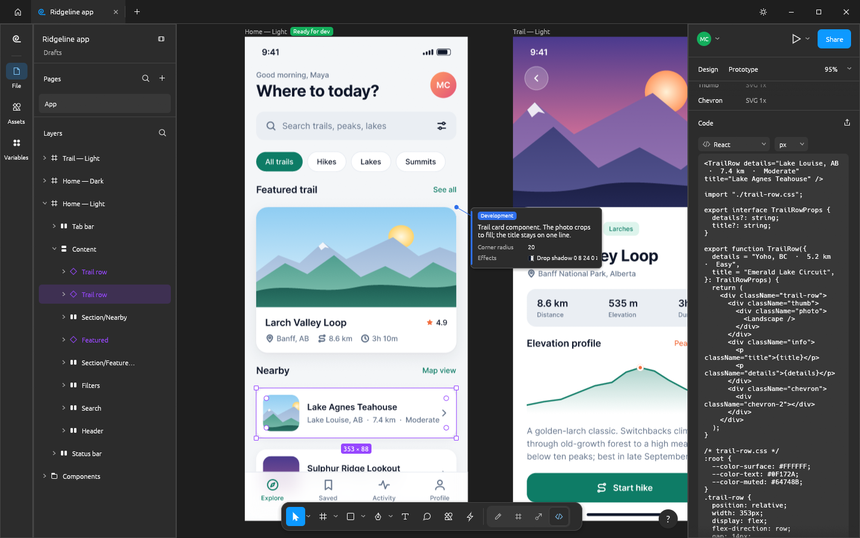
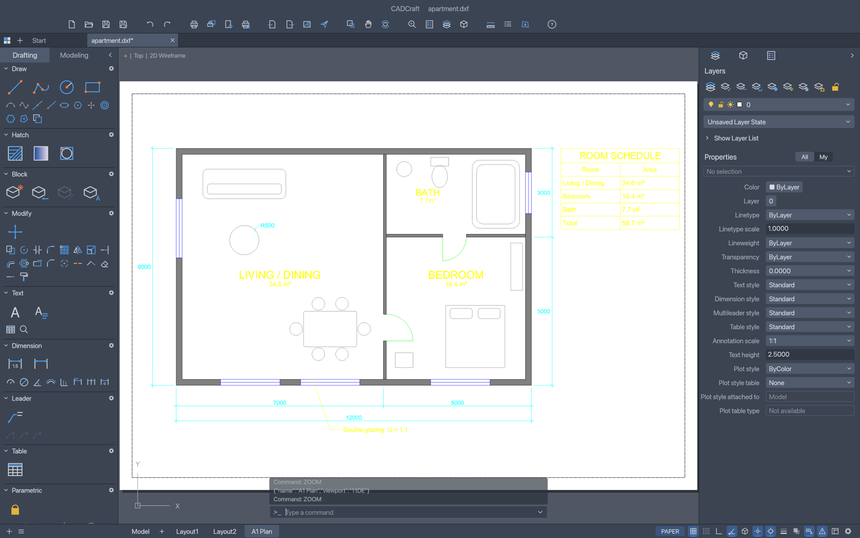
We did not take a screenshot of ArtCraft: its demonstration images are hosted as GitHub attachments or in a media repository with no licence shown, so their rights cannot be verified.
What links the applications
Two repositories act as the base.
craft-libs: the shared libraries
The storytold/craft-libs repository (about 276 stars) is a Cargo workspace gathering the applications’ libraries. Its README lists in particular craft-pdf (PDF parsing and writing), craft-atomic (crash-safe file writing), craft-cms (pure-Rust ICC colour management), craft-print (PDF printing to CUPS and Windows), craft-settings (settings, portable mode) and craft-ui (egui components). Applications include it as a Git dependency at a specific revision.
craft-ai-integrations: the common AI layer
The storytold/craft-ai-integrations repository is little followed (4 stars on the organisation page) and describes itself as a “first draft” and an interim layer: “Nothing here is a final API”. Its idea: set up a tool and its model once, and every app that has that tool uses it. It contains provider adapters (OpenAI-compatible, Black Forest Labs, Vertex, Seedance, ArtCraft), secret stores (OS keychain, passphrase-encrypted file, environment variables), a consent module and local models through ComfyUI.
The “What has and has not been verified” section is precise about the real state: the adapters were tested against scripted servers on localhost; the SAM 3 clients ran for real on one machine with ComfyUI; not verified are any real hosted service, the macOS and Linux keychains, the macOS builds of the test suite, and any app running a tool through this mechanism. Do not present it as a feature delivered to users.
Several applications also advertise an MCP server and a command-line interface (DesignCraft, FigCraft and CADCraft do, according to their READMEs).
Installing ArtCraft
The README points to three sources: stable releases for Windows and macOS on getartcraft.com, development builds on the GitHub releases page, and building from source for Linux (_docs/dev_setup.md). To develop on macOS or Linux, the document gives:
./script/artcraft/unix_dev.sh
ARTCRAFT_DEV_PORT=6200 ./script/artcraft/unix_dev.sh   # optional: another starting port
This launcher starts the front end and the Rust/Tauri part together; it binds the development server to 127.0.0.1, starting at port 5193. On Windows, two PowerShell scripts (windows_frontend_dev.ps1 and windows_rust_dev.ps1) are given. The server-side services and the website live in another repository, artcraft-services.
Licence and limits
- Licence: ArtCraft and the applications cited are dual-licensed MIT or Apache-2.0 at your option (files
LICENSE-MITandLICENSE-APACHEchecked). The ArtCraft name, logo and trademark are not covered; theNOTICEfile also lists third-party items under their own licences (for example ammo.js under the zlib licence, Font Awesome icons under CC BY 4.0). Theartcraft-servicesrepository showed no licence on the organisation page: check it before using it. - Third-party models: the models listed come from external providers, with their own terms. Some are disabled or restricted in the desktop app. The README gives no system requirements, quotas or pricing.
- Hosted services: the 2026 roadmap aims to “remove dependence on ArtCraft hosted services”, which indicates it exists today. The README does not detail what data leaves the machine; read the documentation before sending sensitive content.
- Maturity: “early alpha” or “in development” on the site; FigCraft, DesignCraft and CADCraft estimate their own readiness in their READMEs. ArtCraft’s roadmap mixes technical goals with studio and community goals: these are intentions, not features.
- “Clean-room” claims: several applications describe themselves as “clean-room” reimplementations of commercial software. These are the projects’ own statements, not verified here, and have no link with the original publishers.
What you can measure on the workstation
These are desktop applications (plus a collaboration service for FigCraft): we do not invent metrics. For ArtCraft, what can be measured without assuming anything:
- the time between a generation request and the result, noted by you for each model;
- the outbound network traffic during a generation, with a system tool, to see what leaves the machine;
- the cost billed by the chosen provider, which you match against your generations;
- for the companion applications, the file logs documented in their READMEs (for example
designcraft.log,cadcraft.log).
If you measure model calls in your own tools, see AI agent cost with OpenTelemetry and Langfuse and OpenLLMetry. To choose a model on operational criteria, read choosing your LLM; to compare self-hosted building blocks, the open source AI stack. Agents that drive these tools need guardrails, and a local MCP server is secured as in securing an MCP server.
Good practice
- Read the status section of each README (stage, known gaps) before adopting it for real work.
- Keep provider API keys out of project files and prefer a system keychain.
- Note the versions used: all are 0.x (ArtCraft v0.41.0).
- For sensitive content, work with local models or check the provider’s policy.
Frequently asked questions
Is ArtCraft really open source?
The storytold/artcraft repository is published under a dual MIT or Apache-2.0 licence. The ArtCraft trademarks and third-party models have their own terms, and the server-side services are in another repository.
Do you need to install the whole suite?
No. According to the READMEs, each application “can stand on its own”. The shared libraries are used at build time, not at install time.
Does ArtCraft run on Linux?
The README lists stable builds for Windows and macOS, and points to building from source for Linux.
Conclusion
ArtCraft is an AI creation platform surrounded by a suite of free desktop applications, linked by shared libraries and an AI integration layer that is still provisional. One to follow, with the caution the repositories themselves ask for. Sources: the ArtCraft repository, craft-libs and the applications on getartcraft.com.
span.observer is an independent community blog, not affiliated with Dynatrace LLC or with the projects mentioned. Trademarks belong to their owners. Tools change quickly: check commands and options in their official documentation.